


search icon

InvoiceNow ready!

Sage E-invoicing for Singapore is an InvoiceNow-Ready Service Provider (IRSP) approved by IMDA. Quickly generate, send and receive e-invoices via the Peppol network, accelerating your customer payments. All e-invoices are automatically synchronised with IRAS for seamless reporting.

What is InvoiceNow and GST InvoiceNow?

InvoiceNow is a nationwide e-invoicing network that enables companies of all sizes to:

  • Process invoices in a more efficient manner
  • Reduce business costs
  • Shorten payment cycles

InvoiceNow operates on the open standard Peppol framework, which directly transmits e-invoices in a standard digital format across different finance systems. 

GST InvoiceNow uses InvoiceNow network to enable GST-registered businesses to transmit invoice data to IRAS.

How does InvoiceNow work?

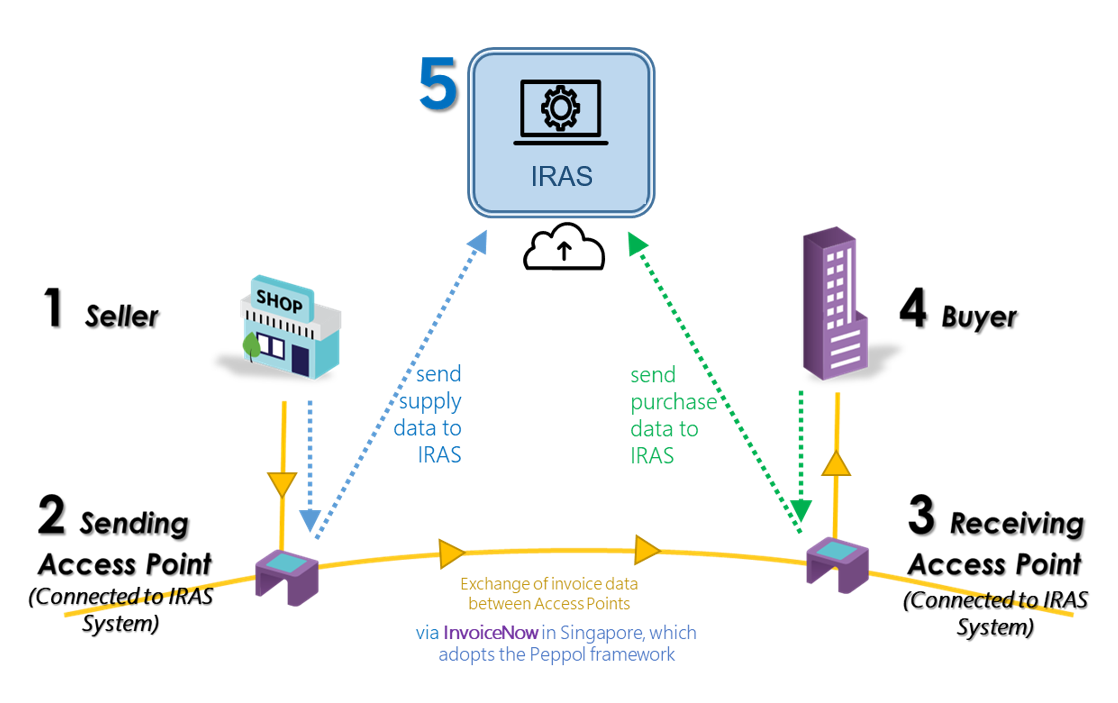
InvoiceNow adopts the Peppol framework which utilises the 4-corner model to direct transmit documents from Sage E-Invoicing solution to the same or another accounting/finance solution without human intervention. In the InvoiceNow network, documents are exchanged using a common XML format through Access Points, which serve as gateways into the InvoiceNow network. Access Points take up the responsibility of mapping documents into the standard format and sending them to the receiving Access Points through the InvoiceNow network.

GST InvoiceNow adopts InvoiceNow for invoice data submission to IRAS and extends the traditional 4-corner e-delivery model to a 5th corner.

1. Seller Creates and Sends Invoice

The seller issues a sales invoice using their Sage application and sends it digitally through the InvoiceNow network.

2. Sending Access Point (Sage)

The invoice first goes to Sage’s Access Point (AP) provider. Here, it’s checked against Peppol standards for accuracy. Once validated, the invoice is sent to the buyer’s AP provider. After the buyer’s AP confirms receipt, Sage’s AP also forwards the invoice details to IRAS.

3. Receiving Access Point (Buyer’s Side)

The buyer’s AP provider receives the invoice and delivers it straight to the buyer’s system.

4. Buyer Processes Invoice

The buyer imports the invoice into their ERP system to record the purchase—no manual data entry needed.

5. IRAS Gets the Data

Finally, the buyer’s ERP sends the purchase invoice to IRAS through their AP provider, ensuring compliance and faster GST reporting.

What are the benefits of e-invoicing?

Reduced costs

Eliminate sending and filing paper invoices. 

Increased productivity

Reduce manual data entry and admin work. 

No lost invoices

Track invoices direcly into accounting software.

Compliance

Always stay up to date with government regulations.

Get paid faster

Reduce invoice processing and validation time.

International growth

Expand your organisation's reach overseas. 

GST InvoiceNow Requirements

In April 2024, Inland Revenue Authority of Singapore (IRAS) announced plans for a phased adoption of InvoiceNow for GST-registered businesses. GST-registered businesses will be required to transmit invoice data to IRAS using InvoiceNow-Ready Solutions via the InvoiceNow network.

Learn more about GST InvoiceNow requirements.

1 November 2025

Companies that register for GST voluntarily within 6 months of incorporation date.

1 April 2026

All new voluntary GST registrants regardless of incorporation date or business structure.

1 April 2028

  • All new compulsory GST registrants
  • Existing GST-registered businesses with total annual supplies1 ≤ S$200,000

1 April 2029

Existing GST-registered businesses with total annual supplies 1 ≤ S$1,000,000

1 April 2030

Existing GST-registered businesses with total annual supplies 1 ≤ S$4,000,000

1 April 2031

Existing GST-registered businesses with total annual supplies 1 > S$4,000,000
1 Total annual supplies refer to the total value of standard-rated, zero-rated and exempt supplies made in all the prescribed accounting periods ending in calendar year 2025.

Get ready for Sage E-Invoicing for Singapore

As an InvoiceNow-Ready Service Provider (IRSP) approved by IMDA, Sage E-Invoicing enables you to quickly generate, send, and receive e-invoices via the InvoiceNow network to both your customers and IRAS.

InvoiceNow FAQs

E-invoicing allows the direct transmission of invoices in structured digital format from one finance system to another, resulting in faster payment.

Pan European Public Procurement Online (Peppol) is a set of artefacts and specifications that enables cross border eProcurement. Peppol is not an eProcurement platform. It is a set of technical specifications that can be implemented in existing eProcurement solutions and eBusiness exchange services to make them interoperable between disparate systems across Europe. It enables trading partners to exchange standards-based electronic documents (e.g. e-Orders, e-invoice, eCatalogues, etc) over the Peppol network. 

Singapore is the first country in Asia and the first outside Europe to establish a Peppol authority.

Sage 300 is the first Sage product in Asia to be accepted by IMDA as being InvoiceNow ready. Other Sage products are being considered for future product enhancements. 

In order to send e-invoices through InvoiceNow, end users will need to:

  • Sign up to an approved Access Point (AP) operator
  • Register and get a Peppol business identity
  • Integrate the accounting and ERP systems to send and receive e-invoices

Another alternative is to approach your Sage 300 partner to help you be InvoiceNow ready.

Yes, IMDA has endorsed Sage 300 as InvoiceNow-ready. See the full list the list from IMDA’s webpage here.

Singapore’s IMDA Nationwide E-invoicing Framework is based on Peppol and localised for the market. It takes into consideration Singapore’s GST tax requirements and helps companies comply with Singapore tax laws through Peppol. E-invoices will be transmitted via the Peppol network in Singapore.

Softcopy pdf invoices will have to be sent to an email address. The recipient’s admin staff will need to enter the contents into their accounting or ERP system, where data entry errors could occur. With a Peppol ready software, it will not be necessary to enter the contents manually as the eInvoice is sent directly to the software.

Currently Peppol is designed for Business to Business (B2B) transactions and is not intended for Business to Consumer (B2C) transactions.

It is not advised to create multiple Peppol IDs for your registered UEN. This may cause confusion when your suppliers are trying to send you an invoice or when your customers are receiving invoices through an unfamiliar Peppol ID.

You can register one Peppol ID for each of your business UENs if you have more than one registered UEN.

Yes, there is an installation required. You will only need to install the E-Invoice Module – to do this contact your Sage Business Partner.

Yes, you will need to register on the Peppol network to receive e-invoices from your suppliers/vendors. Your suppliers/vendors need your Peppol ID to send e-invoices to you.

Yes, your vendors and customers will require a Peppol ID and be registered on the Peppol Network for them to send and receive e-invoices.

Yes, your vendors and customers will need to use a Peppol Ready accounting system, such as Sage 300 to receive and send e-invoices. They will need to have a Peppol ID and be registered on the Peppol Network.

Some of the large MNCs in Singapore have signed up on board with IMDA’s Chain Leader Initiative. Apart from the Singapore government, these Chain Leaders are also spearheading the adoption and usage of e-invoices locally.

As long as your customer or supplier is on the Peppol Network, you are able to send an e-invoice to them even if they are based outside of Singapore.

GST InvoiceNow uses InvoiceNow network to enable GST-registered businesses to transmit invoice data to IRAS.

GST InvoiceNow will be implemented progressively on 1 November 2025 and 1 April 2026. Refer to IRAS website for more details.

Your company must be GST-registered and had already registered in InvoiceNow network using InvoiceNow-ready solution, for example Sage 300. Then you can proceed to activate for GST InvoiceNow within the solution.