How to calculate Net Income (NI): formula and guide
Net income is the profit left after a business subtracts all its expenses from total revenue. Learn the formula, see worked examples in rand, and compare net income with gross income, EBIT, and EBITDA.


Net income is the profit left after you subtract all business expenses from total revenue.
It shows whether your business made a profit or a loss over a specific period and appears at the bottom of the income statement.
You can calculate it using total revenue minus total expenses.
Revenue alone does not show whether your business is profitable.
Costs such as the cost of goods sold, wages, software subscriptions, interest, and tax must also be included.
This guide explains the net income formula, works through practical examples in rand, and compares net income with other measures of financial performance.
Key takeaways
- Net income is the profit remaining after you subtract all business expenses, including cost of goods sold, operating costs, interest, and tax, from total revenue.
- The basic formula is Total revenue – Total expenses = Net income.
- Net income appears at the bottom of the income statement, which is why it is often called the bottom line.
- Net income is different from gross income, operating income, earnings before interest and taxes (EBIT), and earnings before interest, taxes, depreciation, and amortisation (EBITDA).
- Net income does not equal cash flow, so use it alongside cash flow and other financial measures.
Here’s what we’ll cover:
- What is net income (NI)?
- Where is net income shown on an income statement?
- What’s the difference between net income and gross income?
- What’s the difference between net income and operating income?
- How do net income, EBIT, and EBITDA differ?
- Why does net income matter?
- What are the limitations of net income?
- How can you track net income accurately?
- Frequently asked questions about Net income
What is net income (NI)?
Net income (NI), also called net profit, net earnings, or the bottom line, is the profit remaining after you account for all business expenses.
These expenses can include operational costs, cost of goods sold (COGS), labour, interest, and tax.
A positive net income means your revenue is higher than your expenses.
A negative net income means your expenses are higher than your revenue, resulting in a net loss.
Net income helps you understand overall profitability for a defined period.
It is not the same as the cash available in your bank account, because accounting profit and cash flow measure different things.

How do you calculate net income?
The simplest way to calculate net income is to subtract total expenses from total revenue for the same accounting period.
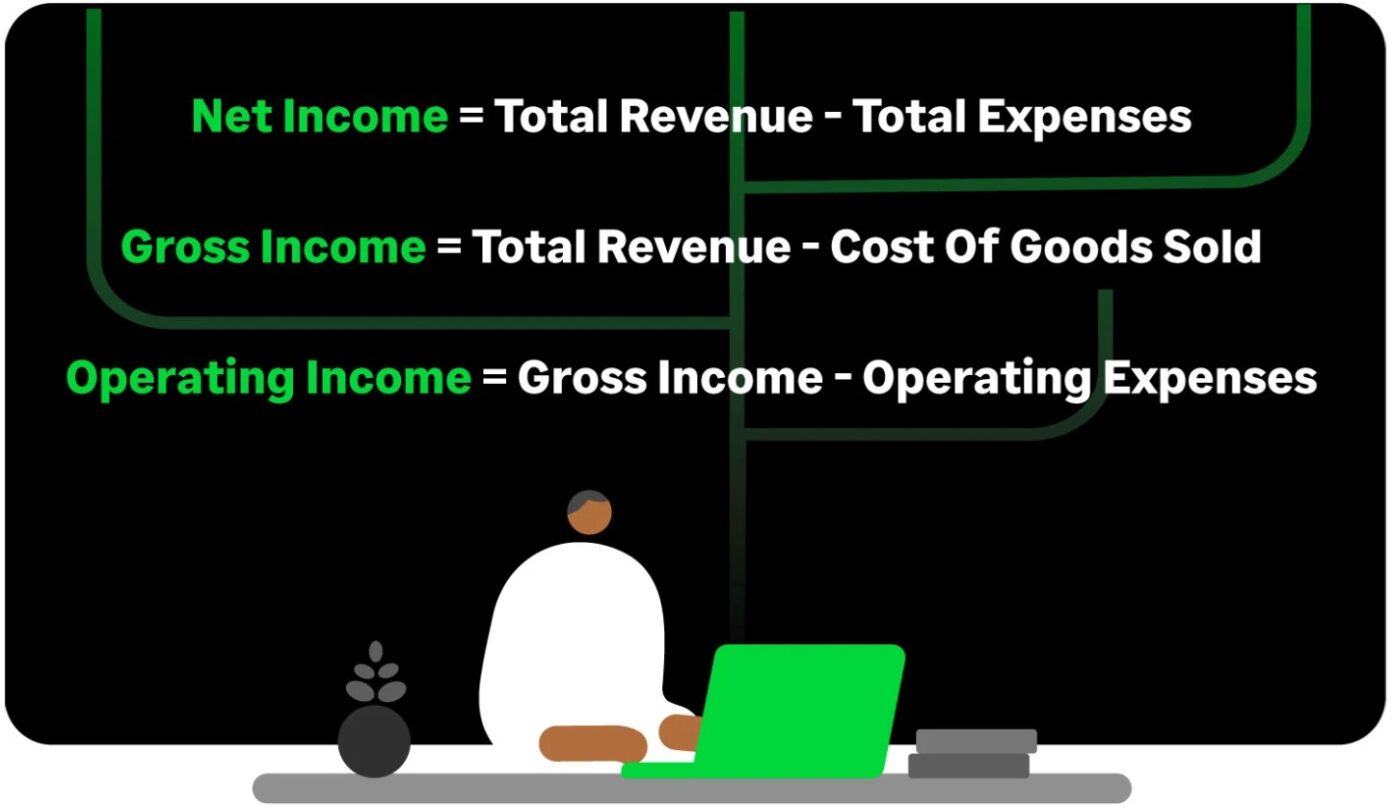
Total revenue – Total expenses = Net income
If you want to show cost of goods sold separately, use this expanded version:
Total revenue – Cost of goods sold – Other expenses = Net income
Before you calculate net income, check that your revenue and expense figures cover the same period and are complete.
What do the terms in the net income formula mean?
Total revenue:
The money your business earns from selling products or services during a defined period.
Cost of goods sold (COGS):
The direct cost of producing or acquiring the goods and services you sell.
This can include raw materials, manufacturing costs, or inventory purchases.
Total expenses:
All costs incurred to run your business, including COGS, payroll, rent, utilities, office supplies, tax, interest, and bank fees.
Gross income:
Revenue after subtracting COGS, but before deducting operating expenses, interest, and tax.
Related Sage Advice glossary: Cost of goods sold (COGS)
How can you calculate net income step by step?
- Choose the accounting period you want to review.
- Add up total revenue for that period.
- Add up COGS and all other expenses for the same period.
- Subtract total expenses from total revenue.
Check whether the result is a profit or a net loss and compare it with previous periods.
Net income formula example
A retail store records R500,000 in total revenue for the year.
COGS is R200,000. Operating expenses, including rent, salaries, utilities, and supplies, total R160,000.
The business also pays R11,000 in tax and R9,000 in interest.
| Item | Amount |
| Total revenue | R500,000 |
| COGS | R200,000 |
| Operating expenses | R160,000 |
| Tax | R11,000 |
| Interest | R9,000 |
| Total expenses | R380,000 |
| Net income | R120,000 |
R500,000 – R380,000 = R120,000
The store has a net income of R120,000 for the year after subtracting all expenses from revenue.
Where is net income shown on an income statement?
Net income appears at the bottom of the income statement.
The statement starts with revenue and then subtracts COGS and other expense categories to show how revenue becomes profit.
This position gives net income its other common name: the bottom line.
Related Sage Advice guide: Income statement template

Net income usually appears on the income statement rather than the balance sheet.
However, if an income statement is unavailable, you can derive net income from the change in retained earnings, provided you also account for dividends paid during the period.
Ending retained earnings – Beginning retained earnings + Dividends paid = Net income
- Find retained earnings in the equity section of the balance sheet.
- Subtract beginning retained earnings from ending retained earnings.
- Add back dividends paid during the period.
For example, if beginning retained earnings are R300,000, ending retained earnings are R450,000, and dividends paid are R50,000:
R450,000 – R300,000 + R50,000 = R200,000
Based on these figures, net income for the year is R200,000.
The income statement remains the preferred source because it shows the revenue and expenses that produced the result.
What’s the difference between net income and gross income?
Gross income and net income measure profitability at different stages.
Gross income shows revenue after direct production or purchasing costs.
Net income shows what remains after all expenses.
Gross income = Total revenue – Cost of goods sold
Using revenue of R500,000 and COGS of R200,000, gross income is R300,000.
If all remaining expenses total R180,000, net income is R120,000.
What’s the difference between net income and operating income?
Operating income measures profit from core business activities before interest and tax.
It is calculated by subtracting operating expenses from gross income.
Net income also includes non-operating items, interest, tax, and one-time costs or gains.
Operating income = Gross income – Operating expenses
For example, revenue of R500,000, COGS of R200,000, and operating expenses of R150,000 produce operating income of R150,000.
How do net income, EBIT, and EBITDA differ?
Net income, EBIT, and EBITDA each show profitability after different costs have been included.
Reviewing them together can help you separate overall profit from operating performance.
| Metric | What it includes | What it helps you understand |
| Net income | All operating and non-operating expenses, interest, and tax | Overall accounting profit after all expenses |
| EBIT | Operating costs, but not interest or tax | Profit before financing and tax |
| EBITDA | Operating costs, but not interest, tax, depreciation, or amortisation | Operating performance before selected non-cash charges |
EBIT = Net income + Interest + Tax
EBITDA = EBIT + Depreciation + Amortisation
For example, net income of R120,000 plus R10,000 interest and R20,000 tax gives EBIT of R150,000.
If depreciation and amortisation total R30,000, EBITDA is R180,000.

Why does net income matter?
Shows overall profitability
Net income includes operating costs, financing costs, and tax, giving you a broad view of profit after expenses.
Supports business decisions
Tracking net income can inform decisions about spending, reinvestment, growth, and cost control.
Helps you monitor performance
Comparing net income across consistent periods can reveal patterns and changes in profitability.
Supports reporting
Net income is reported on the income statement and forms part of financial reporting.
Provides context for stakeholders
Investors, buyers, and lenders may review net income alongside cash flow, debt, and other measures when assessing a business.
Related Sage Advice guide: Financial reporting

What are the limitations of net income?
Net income does not equal cash flow
Under accrual accounting, revenue and expenses can be recorded before cash is received or paid.
Non-cash items such as depreciation and amortisation also affect net income.
Accounting policies and estimates affect the result
Depreciation methods, inventory valuation, expense recognition, and revenue recognition can change reported net income.
One-time items can distort comparisons
An asset sale or restructuring charge can increase or reduce net income for one period without reflecting normal operations.
It does not show operational efficiency on its own
Gross income, operating income, and EBITDA can provide additional views of core operations.
It may not include uncertain future costs
Some potential obligations are not recognised as expenses until they meet the relevant accounting requirements.
Use net income alongside the cash flow statement, balance sheet, and other profitability measures.
If you are unsure how an accounting policy or South African tax rule affects your figures, speak to an accountant or registered tax practitioner.
How can you track net income accurately?
- Record revenue and expenses consistently.
- Use the same accounting period when comparing figures.
- Reconcile bank accounts and review unusual transactions.
- Separate COGS, operating expenses, interest, and tax clearly.
- Review net income alongside cash flow and the balance sheet.
Accounting software can help you keep records, categorise transactions, track expenses, and produce financial statements.
Accurate source data and regular review remain essential.
Consider tracking KPIs that every small business should measure and reviewing balance sheet ratios for managing cash flow to get a complete picture of your financial health.
Explore Sage accounting software
Frequently asked questions about Net income
Does net income include tax?
Yes.
Net income is the profit remaining after tax and other expenses have been deducted from total revenue.
Is net profit the same as net income?
Yes.
Net profit and net income are commonly used to describe the same measure of profit after all expenses.
What is the difference between net income and taxable income?
Net income is an accounting measure of profitability.
Taxable income is calculated under South Africa’s Income Tax Act and may treat expenses and allowances differently.
Speak to a registered tax practitioner or the South African Revenue Service (SARS) for guidance on your circumstances.
Can net income be negative?
Yes.
If total expenses are higher than total revenue for a period, net income is negative.
This is called a net loss.
What is a good net income margin for a small business?
There is no single benchmark because margins vary by industry and business model.
Compare your net income margin with similar businesses and with your own results over time.
How often should you calculate net income?
Many businesses review net income monthly as part of management reporting and at year-end for annual financial statements and tax purposes.
Does net income include value-added tax (VAT)?
Net income is generally calculated using revenue and expenses excluding VAT, because VAT collected on sales is not income and recoverable VAT paid on purchases is not an expense.
VAT treatment can depend on your registration status and the transaction, so check your records or seek professional advice.
Editor’s note: This article was originally published in February 2025 and has been updated for relevance
Subscribe to the Sage Advice enewsletter
Get a roundup of our best business advice in your inbox every month.
