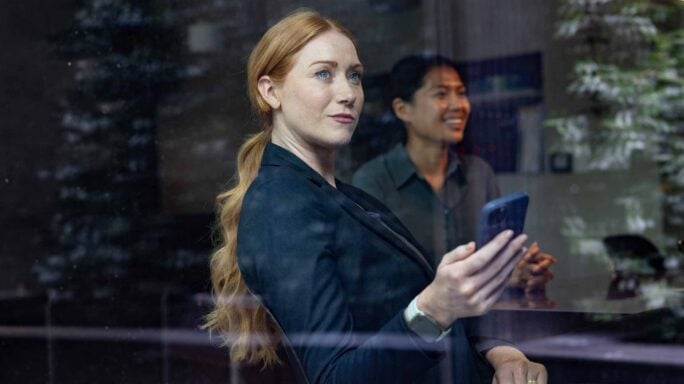
Meet the artist Q&A: Emilie Branford
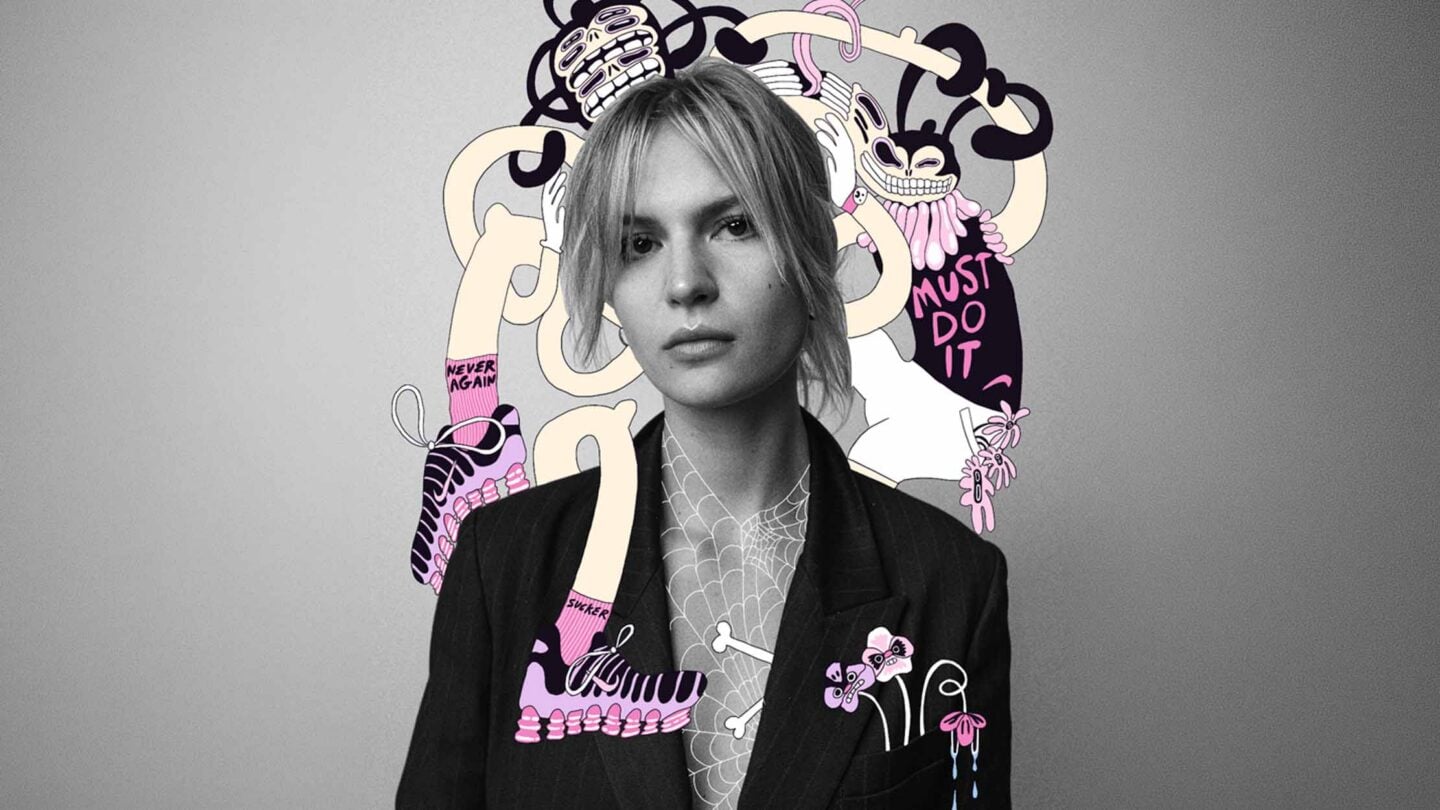
Emilie Branford, known as Twoshoes, is a London-based multidisciplinary artist specialising in expressive monochrome ink portraiture, character-driven illustration and animation. Her work celebrates individuality and the beauty of imperfection; capturing people, personality and energy in fast, committed marks that are entirely her own.
Freelance work rarely comes with a predictable pay cheque, a finance team, or a set of rules for how the week should run.
So, we asked our commissioned artists to how they manage their lifestyle—from managing tax, to the untaught reality of freelance life.
The interviews sit alongside our series of articles for freelancers.
Emilie Branford: Q&A
Q. Who are you and how would you describe your creative practice?
My name is Emilie, otherwise known as Twoshoes, and I am a multidisciplinary artist specialising in expressive monochrome ink portraiture, character-driven illustration and animation.
At the heart of my practice is a deep love of people.
When I draw someone, I take the time to speak with them first, getting to know their personality, their energy, their story, and then interpret all of that through my linework.
Each portrait is a celebration of the individual, and a reflection of what makes them entirely themselves. I call it “imperfectly perfect” because I believe imperfection is innately human, and that is worth celebrating.
Alongside my portrait practice I create a cast of original characters: playful but dark, weird but joyful. They represent the full spectrum of human experience; the light and the shadow.
I have been animating these characters too, bringing them to life through smear animation, so the people who inspire me don’t just become portraits—they evolve into living, moving characters within the Twoshoes universe.
It is a world I am actively building, and one I hope to expand into sculpture one day.
Q. When you first started out, what was the biggest “untaught reality” about running a business, and how did you navigate it?
The biggest untaught reality?
You’re on your own, buddy.
When you start out, it’s easy to be naive. You look around and see plenty of people running their own businesses and think “if everyone’s doing it, it can’t be that hard”.
But there are so many elements to running a business, especially as an artist, that nobody warns you about. It can feel overwhelming and daunting when you don’t have the knowledge or the support system around you.
Of course, you can watch a YouTube video or search online, but when you’re actually in the middle of it dealing with invoices, clients, self-doubt, taxes, all of it—it becomes a real test of mental fortitude.
What I’ve learned is that it’s a long process of trial and error, and that’s okay. In a way, it’s quite like art making itself. You’re building something beautiful, but you have to make plenty of mistakes and learn plenty of lessons to get there.
I think of myself like a flower. Before it blooms, a seed has to germinate, grow, and soak up plenty of sun. We don’t expect a flower to bloom overnight, so why would we expect that of ourselves?
That patience and self-compassion has been everything.
Q. Your commission explores the theme: “the unpaid admin Sunday”. Can you talk us through a moment in your career where you felt that way, and what helped you move past it?
The stress of trying to keep it all together.
You try to enjoy life, but carry all the weight of waiting to be paid; this hits hardest on a Sunday.
Your friends with 9-5 jobs are free, suggesting a coffee walk or a lazy afternoon, and meanwhile you’re still checking your emails, waiting to hear back from a client you’ve been chasing or for an invoice to finally clear.
And then you remember… it’s Sunday. Nobody is emailing you back.
Obviously. As an artist, I always want to create. And honestly, there have been moments where I’ve prioritised making over admin. Which in some ways is a good thing, because it means my practice keeps evolving and growing stronger. But it also means the admin quietly piles up in the background, and before I know it, the Sunday scaries have become the admin Sunday scaries. What helped me move past it was learning to plan ahead.
Instead of letting tasks accumulate until the weekend, I try to squeeze admin into the week—ideally first thing in the morning, an hour or two to get the boring stuff out of the way. That way, by the time I sit down to actually make art, I can give it my full focus.
And Sunday? Sunday can just be Sunday.
Q. How did you visually translate that feeling into this piece, and what details should viewers look out for?
As artists, we have to wear so many hats: manager, accountant, cheerleader, creative.
But ultimately, we are just people too.
In this piece I wanted to bring that idea of “different hats” to life literally.
It’s a self portrait: me, surrounded by all the admin, trying to stay on top of it all—but wearing a glam dress and heels.
Because the second it’s done, I want to go out and enjoy my life.
My favourite detail is the pencil earring. It’s cute, but it’s also the fundamental tool of the artist. We need it for everything.
And then there’s the hat on the left, that’s actually a visor. Inspired by the iconic green visors worn by accountants and bankers, designed to reduce eye strain from working under direct light for long hours. In the piece it’s rendered in monochrome, as all my work is, but in my mind it’s green (and it feels extra fitting as a narrative instrument as green is Sage’s colour).
There’s also something so poetic about an artist borrowing the uniform of the accountant for a day. I’m tempted to get one just to wear while doing my taxes. Just for the vibes.
Q. Your commission explores the theme: “the paralysis caused by tax jargon”. Can you talk us through a moment in your career where you felt that way, and what helped you move past it?
Not to scare any aspiring creatives reading this, but I think I can say on behalf of most artists that this paralysis happens on a regular basis.
Not only are we navigating all of this on our own, which is a daunting enough feat in itself, but when you’re suddenly faced with a letter or email stuffed full of jargon and terminology you’ve never heard before, it’s just as anxiety-inducing as being stranded on a desert island.
You want to stick your head in the sand and wait for it to disappear.
But you also know it won’t, and that if you leave it, more letters will follow, all plastered in what feels like hieroglyphics.
What helped me move past it was swallowing my pride and asking for help.
I used to procrastinate on these things because I felt embarrassed not knowing what I was doing; it became a question of pride.
Then I realised I needed to be a little kinder to myself. I’m still figuring it out, and so are a lot of people. I’m not alone in this.
Luckily, I have my dad, who is always happy to help when I have questions. He has more life experience, and I trust and value his knowledge enormously. My advice? Find your person. Someone you can turn to—because people genuinely want to help.
Think about it: if someone came to you with a question, you’d help them, right?
Exactly. I also think it’s really important to practise being present.
In moments of overwhelm, I used to run away. Now I take a breath and remind myself that life is so big and wide and beautiful, and this stressful moment doesn’t have to be a stressful one. We can reframe it as a learning experience.
I’m an optimist, and honestly, optimism is paramount in every aspect of life.
Q. How did you visually translate that feeling into this piece, and what details should viewers look out for?
With this piece I wanted to create an emotional depiction rather than a literal one, by capturing the feeling itself, rather than illustrating the scene.
In my work I often reference movement and expressive eyeballs (it’s kind of my thing).
Here I’ve used those motifs to visualise the experience of overthinking.
The eyeballs bubble and expand outward from the figure’s head, representing thoughts spilling over & that sensation of reading tax jargon you don’t understand while your mind races at a million miles an hour, catastrophising before you’ve even finished the sentence.
Look out for the figure’s posture too.
They stand completely rigid and stiff, and their belt is pulled as tight as it can possibly go. The belt is doing a lot of work in this piece. It’s a visual metaphor for that feeling of suffocation and paralysis. The sensation of being held so tightly by something you can’t quite name that you can barely breathe.
Together, the expanding eyes and the constricting belt tell the same story from two directions: the mind spinning outward, the body locked inward. That tension is the piece.
Q. How did you find/refine your style?
Hours and hours and hours of trial and error.
For a style that looks so fluid and spontaneous, what has gone into developing it has been hard work, dedication, and real blood, sweat and tears.
I’ve experimented endlessly, dipping into different materials, different approaches.
When I find something that works, I take that nugget and test it in a new context, see how it behaves, and keep going.
But fundamentally, what I’ve learned is that the key to finding your style is returning to the fundamentals of your “why.” Why do you make art? How do you enjoy making it? Because at the end of the day, you’re the one doing it—you’ve got to love it.
For me, it’s the expressive movement of ink.
Working with it feels dynamic, almost like a performance—a ritual of channelling energy directly onto the page.
I champion imperfection, and I love creating art of people, and through that long process of trial and error I had an epiphany: ink as a material perfectly encapsulates my ethos. It’s committed, immediate and beautifully flawed.
I think it also helps that I am a deeply passionate person. I have big aspirations, a vision, and a promise I made to myself, that I would never stop until I reach the stars. I think of the little girl drawing pictures on her wooden kitchen table, which funnily enough is now my desk covered in splattered ink, and I think of how proud she would be. I do it for her.
Q. What is one habit, tool, or piece of financial or business advice you wish someone had given you on day one?
Don’t be afraid to ask for help.
It sounds simple, but it took me longer than I’d like to admit to actually do it.
There’s a strange shame that creeps in when you don’t know something, especially around money and business.
It’s almost as if you’re supposed to have been born knowing how VAT works or what a self-assessment tax return actually means.
You’re not… Nobody is.
Honestly? I’m still figuring it out. I don’t have all the tools yet, and I’m learning as I go.
But what I’ve found is that admitting that out loud, to another person, is the thing that unlocks everything. Whether it’s a parent, a friend who’s been self-employed longer than you, or a tool that simplifies the process and translates the jargon into something human, just ask.
Use it and let it help you. The sooner you stop pretending you have it all together, the sooner you actually start to get it together.
Q. What does ‘making it’ as an independent freelancer look like to you today?
The obvious answer would be a flood of clients, a packed diary, and lots of cash coming in, and yes, that’s part of it.
But honestly, I think “making it” is something quieter than that.
To me, “making it” looks like being in control.
Having a business that feels strong and sustainable; not perfect, but resilient.
It means reaching a point where the bumps in the road don’t send you into a spiral, because you have the tools, the experience and the selfbelief to handle them calmly and move forward.
It’s not the absence of hard days. It’s the confidence that you can navigate them.
I’m not there yet and that’s okay. I’m building toward it, one lesson at a time.
And the fact that I’m still here, still creating, still figuring it out? That already feels like something worth celebrating.
This interview was carried out by The Elephant Room on behalf of Sage.
Flexible, free, HMRC-approved accounting
Get one free app to manage income, payments, and taxes. Sage Sole Trader is free tax and accounting software built for freelancers like you.

Browse more topics from this article
Explore more wisdom
Allowable expenses for creative freelancers: What can you claim?
Software, studio hire, a new laptop, or coffee while you work: which costs count as business expenses? Here’s how to separate claimable costs from personal spending and keep useful records.