How to write a business quote (free quote template to download now)
Learn what a business quote should include, how it differs from an estimate or an invoice, and the mistakes that catch small businesses out. Download the free UK quote template, with built-in VAT calculations and an acceptance section, and start sending professional quotes straight away.


Sending a quote should be the easy part of running a business. A customer asks how much something costs, you tell them, they agree, and then the work begins.
In reality, an unclear scope, endless revisions, and VAT confusion can turn a straightforward job into a billing headache.
Getting it right doesn’t have to be complicated. A well-structured quote sets clear expectations before any work starts, and that clarity is what avoids a headache and gets you paid on time.
According to a 2025 report by GoCardless and the Federation of Small Businesses, 24% of small firms in the UK say they receive payments that are up to 60 days late. Unclear paperwork at the start of a job only adds to that risk.
This guide covers what a business quote should include, how it differs from an estimate or a business invoice, and the mistakes that catch small businesses out.
Key takeaways
- A business quote is a fixed-price offer, and it can become legally binding once your customer accepts it — an email saying “yes, please go ahead” can be enough to show acceptance under UK contract law, so the wording of your quote matters.
- Use a quote when you can price the job with confidence, and an estimate when costs depend on unknowns — a graphic designer can quote a fixed fee for a locked scope, while a builder or mechanic should estimate until the work is opened up.
- Every quote needs a unique reference number, a specific description of the work, net/VAT/gross pricing, payment terms, and an expiry date — vague descriptions like “garden work” are one of the most common causes of disputes.
- You only charge VAT if you’re VAT-registered — the UK registration threshold is £90,000 in taxable turnover over 12 months, and if you are registered, the VAT amount must be shown separately.
- Set a validity period on every quote — seven days suits trades with fluctuating material costs, 14 days works for most service businesses, and 30 days suits larger clients who need internal sign-off.
Here’s what this article will cover:
- What is a quote in business?
- When businesses typically use quotes
- Formal quotes vs informal pricing
- Is a quote legally binding in the UK?
- Quote vs estimate vs invoice: what’s the difference?
- What should a business quote include?
- How to write a professional quote for your business
- Free quote template for business
- Common mistakes to avoid when creating quotes
- How long should a quote be valid for?
- How quoting software can save time as your business grows
- Frequently asked questions
What is a quote in business?
A business quote is a formal written document you send a customer before any work begins. It lays out the specifics of what you’re offering and what it will cost, so both sides are clear before anything gets started.
Most people have given an informal or ballpark price at some point. “It’ll probably be around £300” over the phone is very different from putting that figure in writing with a full breakdown. The written quote is what gives you protection if a dispute comes up later.
When businesses typically use quotes
You’d typically send a business quote when you have enough information to price a job accurately. That might be after an initial call, a site visit, or a detailed brief from the customer.
Some common examples include:
- A freelance photographer confirming a fixed day rate for an event
- A landscaper pricing a garden clearance after visiting the property
- A small print shop quoting for a batch of branded materials
The quote confirms the agreed scope, price, and any key terms, giving the customer a clear record to review before they commit. It protects both parties by reducing misunderstandings and making the agreed work clear from the start.
Formal quotes vs informal pricing
An informal price gives you flexibility but leaves more room for confusion and change. If a customer remembers a different figure from the one you quoted verbally, you have nothing to fall back on.
A formal company quote template removes that ambiguity. It creates a clear record of the agreed scope, at what price, and under what terms.
Is a quote legally binding in the UK?
This is one of the questions small business owners ask most often, and the short answer is: it can be.
In the UK, a business quote can become legally binding once a customer accepts it. Depending on how it’s worded, a quote may constitute a formal offer or an invitation for the customer to make one, either way, once both parties have agreed the terms, a contract can exist. That agreement doesn’t always need a signature to be valid.
An email saying “yes, please go ahead” can be enough to show acceptance under UK contract law, which is why the wording of your quote template matters. If your quote states you’ll complete a job for £800 and the customer accepts it, you’re generally expected to honour that price.
There are nuances to this, particularly around what counts as a valid offer and acceptance. If you’re ever unsure about your specific situation, it’s worth speaking to a legal professional.
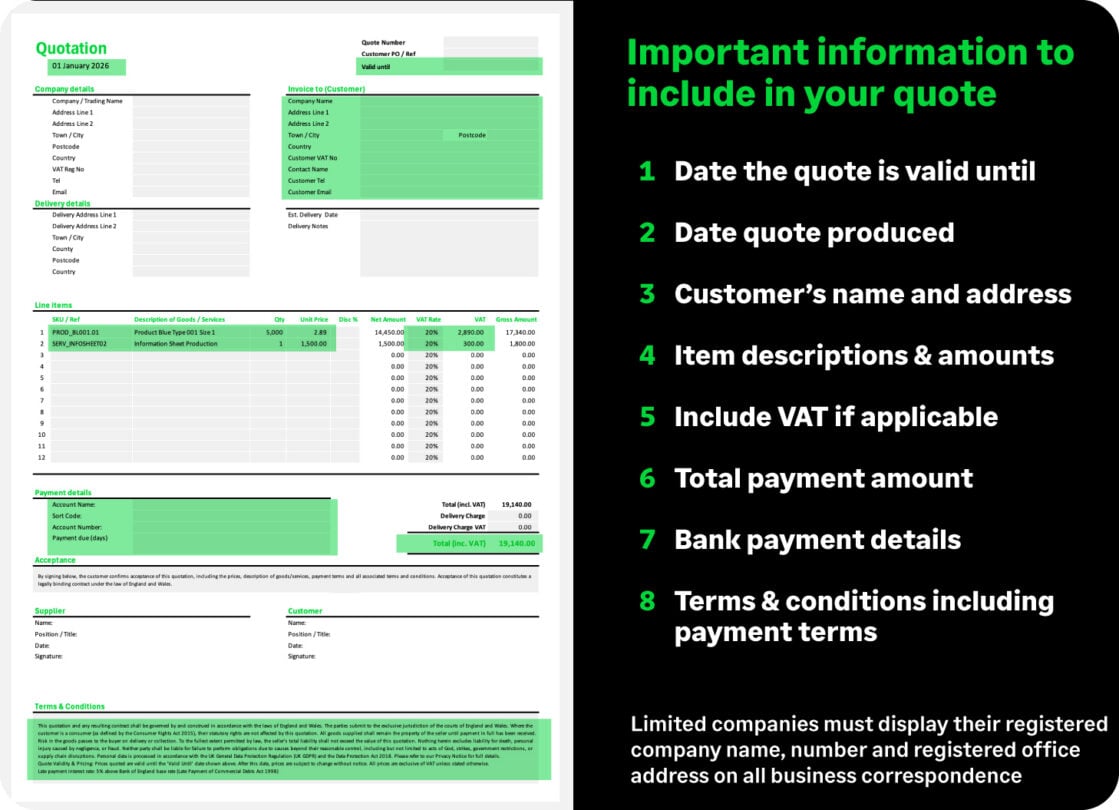
What you can control is making sure your quote always includes:
- A clear description of the work or products
- A validity period
- Your payment terms
- An explicit acceptance process
The free business quote template above covers these points, including a dedicated acceptance and authorisation section for both parties to sign. For more on managing the financial side of your business, our guide to setting up self-employed finances is a good place to start.
Quote vs estimate vs invoice: what’s the difference?
Each of these three documents comes up at different stages of a job, and mixing them up can confuse you and your customer.
A quote is a fixed price offer. Once your customer accepts it, then you’re bound and have entered into a contract to deliver at that price.
An estimate is an informed approximation. The final cost can change depending on how the work unfolds, and your customer should understand that upfront.
An invoice is what you send after the work is done. It’s your formal payment request. If you want to understand how invoicing fits into your overall cash flow, our guide to managing accounts as a sole trader is worth a read.
When should you use a quote instead of an estimate?
When you have enough data to calculate the exact cost of a project, use a quote. To get those details, you’ll need to ask targeted questions to understand the full scope of the project, conduct a site visit if relevant, and thoroughly break down material and labour costs.
Use an estimate when the full scope isn’t clear yet, or when the job involves variables you can’t predict at the outset.
Here are some practical examples to help you decide:
Graphic designer (fixed-fee service): send a quote
- Why: The deliverables are finite and predictable.
- What to calculate: Total design time plus a set number of revision rounds. Because the scope is locked, you can confidently offer a fixed fee.
Builder (materials & labour): send an estimate
- Why: There are too many hidden structural blind spots before breaking ground.
- What to consider: You can price known materials, but you must factor in unpredictable variables such as ground stability, hidden plumbing or electrical issues etc.
Commercial cleaner (recurring service): send a quote
- Why: The tasks and environment are controlled and repeatable.
- What to calculate: Square footage, room count, and time needed per visit to lock in a guaranteed weekly rate.
Car mechanic (unpredictable service): send an estimate
- Why: The true problem is hidden until after you’ve completed the diagnostic phase.
- What to consider: A warning light could be a cheap sensor or a major engine failure. The estimate covers initial diagnostic labour, with a firm price postponed until you find the actual cause.
As a general rule, if you control the variables and can price it with confidence, use a quote. If costs depend on hidden or unknown factors, an estimate provides a safety net.
What should a business quote include?
A good quote template covers everything your customer needs to make a decision and everything you need if a dispute comes up later. Here’s what to include:
Business name and contact details
Your trading name, address, phone number, and email. If you’re a limited company, you’re legally required to display your registered company name, registration number, and registered office address on all business correspondence.
Client details
Your customer’s name or company name, address, and contact details such as email and phone number. This confirms who the quote is addressed to and avoids any confusion if they forward it internally.
Unique quote number
Give every quote its own reference number. It makes tracking straightforward and gives both sides something to refer to if questions come up later.
Description of goods or services
Be specific here. Vague descriptions are one of the most common causes of disputes. Instead of “garden work,” write “removal of two raised beds, lawn re-turfing across 20 square metres, and disposal of waste materials.”
Prices: net, VAT, and gross
Break your pricing down clearly. Your customer should be able to see the net amount, any VAT applied, and the gross total without doing their own calculations. The free business quote template includes a line item table that calculates these figures automatically.
VAT rate
If you’re VAT-registered, you need to show the VAT rate applied to each line item. The standard VAT rate in the UK is 20%, though some goods and services qualify for the reduced rate of 5% or zero rate. If you’re not VAT-registered, you don’t charge VAT and should not include it on your quote.
Validity period
Material costs change, availability shifts, and an open-ended quote can come back to cause problems months later. This is why every quote should have an expiry date. We cover validity periods in more detail further down.
Payment terms
Let your customer know when payment is due and how you’d like to be paid. Typically, this includes the payment deadline, accepted methods, early payment discounts, and any fees for late payments. Setting out your payment terms at the quote stage means there are no surprises when the invoice arrives, so you can get paid faster and keep cash flow moving.
Terms and conditions
This is the section most people skip and probably shouldn’t. Your terms and conditions set out what happens if the scope changes, what your cancellation policy is, and how disputes are handled. The free quote template includes a basic terms and conditions section you can adapt to your business.
Do quotes need to include VAT?
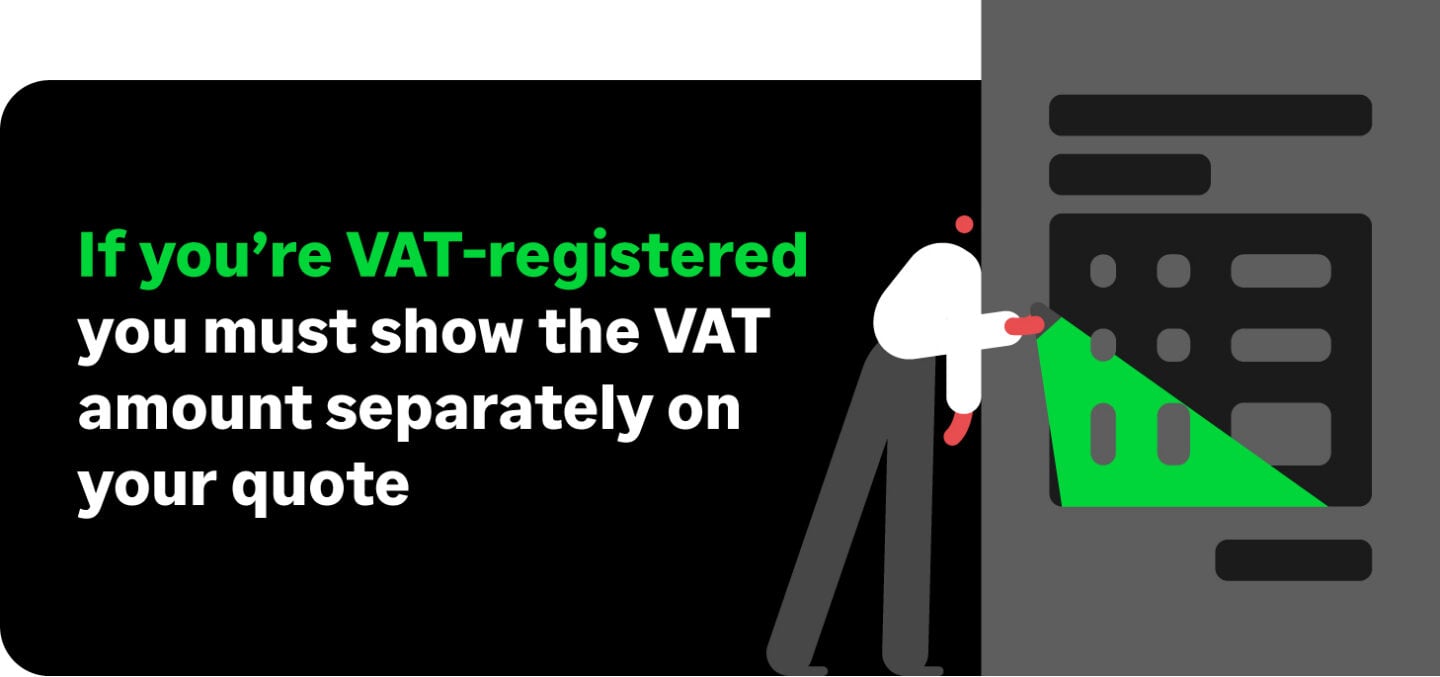
Only if you’re VAT-registered. The current VAT registration threshold in the UK is £90,000 in taxable turnover over a 12-month period, as confirmed by HMRC. If you’re below that and haven’t registered voluntarily, you don’t charge VAT and your quote should make that clear.
If you’re VAT-registered, you must show the VAT amount separately so your customer can see exactly what they’re paying.
How to write a professional quote for your business
Writing a professional quote doesn’t have to take hours. Once you have a template in place, it’s mostly a case of filling in the details accurately and making sure nothing gets missed. Here’s how to do it well.
Add your business and customer details
Start with your trading name, address, and contact details at the top. Then add your customer’s details directly below. If you’re quoting for a business rather than an individual, include the company name and the name of the person you’re dealing with.
Getting this right matters more than it sounds. A quote addressed to the wrong person or company can slow down the approval process before work even begins.
Clearly describe the work or products
This is where most quotes fall short. Write out exactly what you’re providing, in plain language your customer will understand. If you’re a tradesperson, specify materials, quantities, and the scope of work. If you’re a service provider, describe the deliverables, whether you’re pricing by hour or flat rate, and what’s included.
Anything outside the scope of your quote should also be stated clearly. That way, if extra work comes up, you have a basis for raising a separate charge.
Set out your pricing clearly
List each item or service as a separate line, with the unit price, quantity, and net total shown for each. Then show the VAT amount and gross total at the bottom. Your customer should be able to follow the numbers without asking you to explain them.
If you’re offering a discount, show the original price and the discounted figure separately. Customers appreciate seeing the saving spelled out clearly.
Include your terms, conditions, and expiry date
Before you send the quote, make sure your payment terms are clearly stated, along with your cancellation policy and what happens if the scope changes. Then set an expiry date. A quotation template without a validity period is an open-ended commitment, and you don’t want to be held to a quoted price months down the line.
Free quote template for business
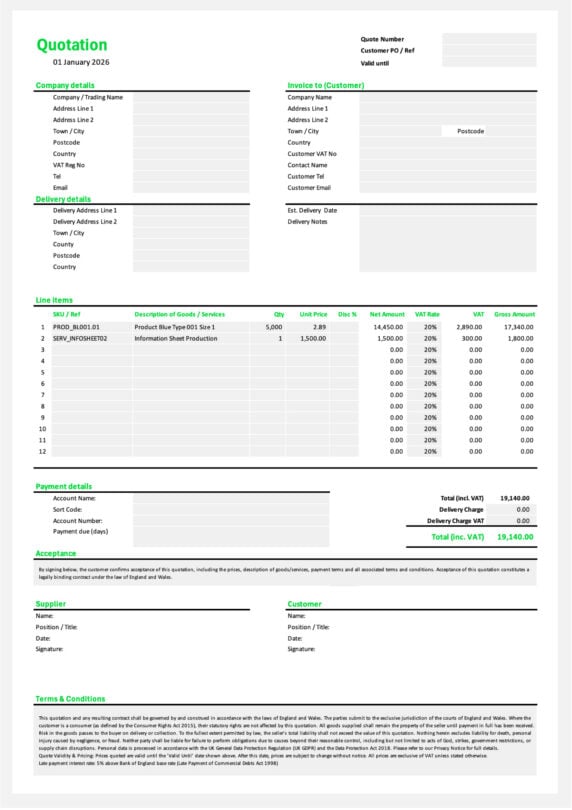
Putting together a business quote from scratch every time is time you don’t need to spend. This free quote template is designed for self-employed people and small businesses in the UK who want to create business quotes professionally without the admin headache.
It covers the following:
- Your business and customer details
- A line item table for goods or services, with net, VAT, and gross calculations built in
- A dedicated section for payment terms and bank details
- Terms and conditions you can adapt to your business
- An acceptance and authorisation section for both parties to sign
The template is set to GBP and reflects UK VAT requirements, so it’s ready to use straight away. If you’re not VAT-registered, leave the VAT column blank.
Common mistakes to avoid when creating quotes
Even straightforward quotes can cause problems if a few key details get missed. These are the ones that come up often.
Vague descriptions
Writing “consultancy work” or “building services” without any further detail leaves too much room for interpretation. Be specific about what’s included and what isn’t.
Missing expiry dates
Always set a validity period on your business quote. Without one, you could find yourself being held to a price that no longer reflects your actual costs.
Forgetting VAT
If you’re VAT-registered and you send a quote without showing VAT separately, your customer may assume the price they see is the total they’ll pay. That conversation is awkward to have after they’ve already agreed. Show the net amount, the VAT rate, and the gross total clearly on every quote.
Using inconsistent pricing
If your day rate on a quote doesn’t match your previous quotes or your website, customers notice. Keep a record of your standard rates and stick to them. Inconsistency can undermine trust before work even starts.
Not keeping records
Every quote you send is a business record. If a dispute comes up later, you’ll want a copy. Managing your accounts and bookkeeping from the start will save you a lot of trouble down the line.
How long should a quote be valid for?
There’s no legal requirement for how long a business quote must remain valid. The validity period you set is entirely your call, and it should reflect how quickly your costs or availability are likely to change.
As a general guide:
- Seven days works well for jobs where material prices fluctuate, such as construction or manufacturing.
- 14 days suits most service-based businesses and gives customers enough time to decide.
- 30 days is common for larger projects or enterprise clients where the customer needs internal sign-off before committing.
Why your validity period matters
Setting a realistic period protects you from being locked into a price that no longer works, or committing to a project you no longer have time for. It also creates a natural prompt for your customer to make a decision, which keeps your pipeline moving.
If a customer comes back after your quote has expired, you’re under no obligation to honour the original price. Treat it as an opportunity to reissue an updated quote template that reflects your current costs.
Industry flexibility
Some industries have established norms around validity. Tradespeople working with materials that shift in price often set shorter windows. Freelancers and consultants tend to allow longer periods because their costs are more stable.
The right period for your business comes down to how much your costs vary and how quickly you typically win work. If you’re unsure, 14 days is a reasonable starting point for most small businesses.
How quoting software can save time as your business grows
A free quote template is a great starting point, and for many small businesses it’s all you need in the early stages. But as your workload grows, creating and tracking quotes manually can start to take up more time than it should.
This is where software can make a real difference.
From quoting to invoicing in fewer steps
One of the advantages of using accounting software is how it connects your quotes to the rest of your finances. When a customer accepts a business quote, you can convert it directly into an invoice without reentering any details. That removes a step that’s easy to get wrong when you’re doing it manually.
It also means your records stay consistent. The description, pricing, and customer details on your invoice match the quote exactly, which reduces the chance of a dispute further down the line.
Accuracy and professionalism
Accounting software calculates net amounts, VAT, and gross totals automatically. You’re not relying on a spreadsheet formula or doing the sums yourself, which means fewer errors on documents your customers will scrutinise.
A consistently formatted quote also sends a signal to customers. It shows you run your business with attention to detail, which matters when you’re competing for work.
Keeping track of where things stand
When you’re managing several quotes at once, it’s easy to lose track of which ones are pending, which have been accepted, and which have expired. Software gives you a clear view of all of that in one place, so nothing slips through.
If you’re self-employed or running a small business and want to see how software can simplify your quoting and invoicing, Sage for self-employed businesses is worth a look.
Frequently asked questions
Send a business quote once you have enough information to price the job accurately. That usually means after an initial conversation, a site visit, or a written brief from the customer.
Sending a quote too early, before you fully understand the scope, increases the risk of underpricing the work or having to revise the figure before the customer has even agreed.
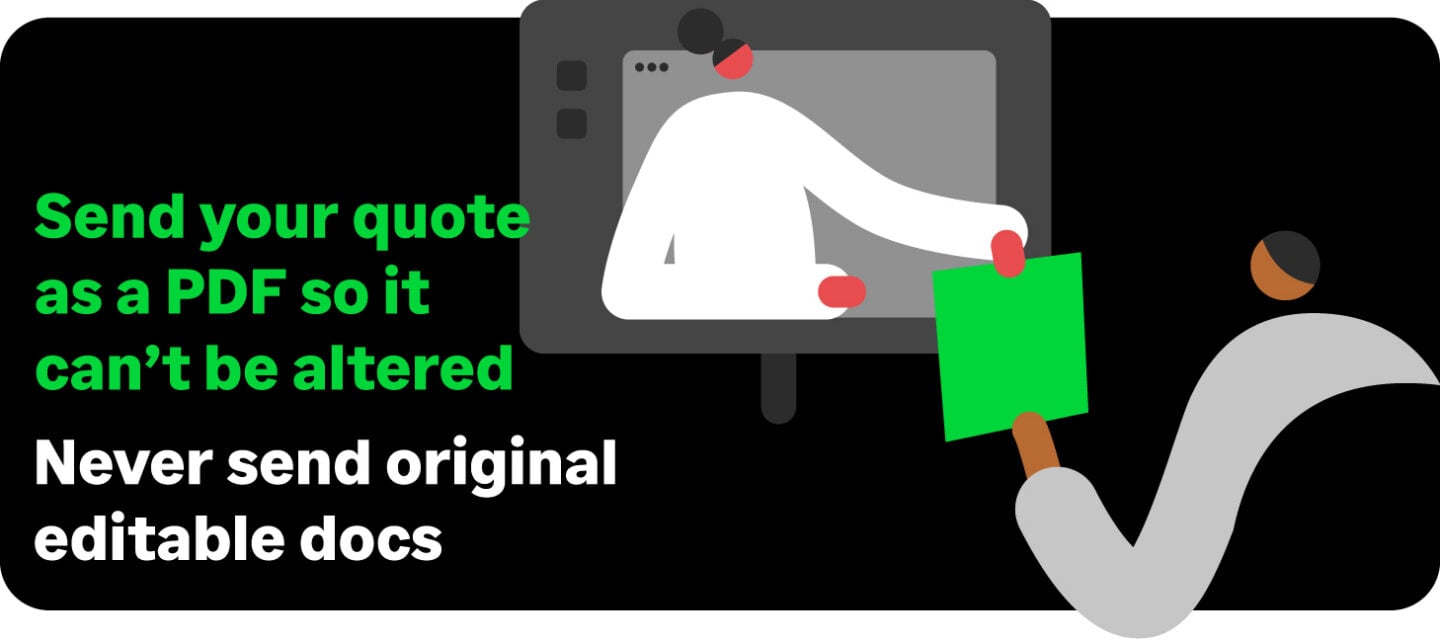
Yes, PDF is the safest format. It preserves your formatting across different devices and can’t be edited by the person receiving it. Use our quote template to format and calculate your quote and then save as a PDF to send to the customer.
Sending a quote as a Word or Excel file risks the layout shifting on the recipient’s machine, and the recipient can edit or accidentally alter the figures.
Yes. Every quote you send is a business record and you should store copies in an organised way. If a customer disputes the scope or price of a job, your original quote is your evidence.
Good record keeping also makes it easier to track which quotes are pending, which have been accepted, and which have expired. Our guide to sole trader record keeping covers what records you’re expected to keep and for how long.
Yes, and it’s more common than you might think. A customer might ask you to reduce the price, adjust the scope, or change the payment terms. You’re under no obligation to agree, but it’s worth having a clear sense of where your floor is before those conversations happen.
If you do agree to changes, reissue an updated business quote so both sides have a record of the revised terms. Never rely on a verbal agreement once a written quote is already in play.
This article was verified by a UK-based Accountant in June 2026. Accounting rules are complex and change frequently and we recommend you seek any accounting advice from a qualified accountant or tax professional.
Browse more topics from this article
Explore more wisdom

How to get ready for Making Tax Digital for VAT
You don’t usually need to sign up for Making Tax Digital for VAT. Find out how it applies, what software you need, and how to keep digital records and file VAT Returns.