Save time to focus on your business with Sage Accounting
search icon

Seamless and stress-free

Self-assessment accounting, simplified

By staying on top of the numbers, sole traders and small businesses have all the information they need to record transactional data and get tax confident. You or your accountant has the ability to easily submit a self-assessment tax return.

What is income tax self-assessment?

Revenue use self-assessment to calculate the tax on your income. It’s one type of tax return that often applies to self-employed people, or on supplemental or non-PAYE income. Tax is usually deducted automatically from wages, pensions, and savings but if you receive further income, it’s important to report this to Revenue by sending a self-assessment tax return each year. You can get your self-assessment tax return sorted in three simple steps.

Step one: Register

Make sure you’ve registered with Revenue, through your local Revenue office or through Revenue Online Service (ROS), if you meet the requirements for self-assessment.

Step two: Submit

31 August is the deadline to submit a self-assessment if you would like Revenue to calculate your return for you.

Step three: Pay and File

In 2024 the deadline has been extended to 14 November to those customers who both pay and file through Revenue Online Services.

Stay organised with digital records

Digital records are a simple and secure way to store your financial records in one place:

  • Create sales and purchase invoices which automatically add to your accounts
  • Use the Sage app on your phone or tablet to track admin on the go
  • Easily access, amend or remove information to improve accuracy

Save time with automation

Save time and avoid mistakes with automated processes that simplify preparing for self-assessment:

  • Connect your bank feeds to automatically import transactions
  • Match your transactions with invoices easily using automated technology
  • Create recurring invoices to save time for your business

Plans to support you and your business

Get full access to your product, and upgrade or cancel at any time. No long-term contracts, commitments or hidden fees.

Accounting Start

Great for sole traders and freelancers.

Single user

per month / excl VAT*

*Get 90% off for 3 months, then €17/€34 + VAT/mo (tier depending). Terms and conditions apply.


Try before you buy. Skip the offer and get 1 month free on Accounting Start, or Accounting.


(1) Starting at 5 employees for €1.30 (offer price when coupled with Sage Accounting) per month + VAT with the option to add employee tiers for up to 100 employees. RRP from €13 + VAT per month (after offer).

Self-assessment FAQs

By 31 October in a tax year, you must:

  • pay your preliminary tax for that year
  • file your self-assessment tax return for the previous tax year
  • pay any balance of tax due for the previous year

For example, by 31 October 2024 you must:

  • pay your preliminary tax for 2024
  • file your 2023 self-assessment tax return
  • pay any Income Tax balance for 2023

If you pay and file through the Revenue Online Service (ROS) , the deadline is 14 November.

To avoid interest charges, please ensure you file by the correct due date.

If you are self-employed, you always have to complete a self-assessment tax return (unless your trading income is exempt under the trading allowance). It does not matter whether you make a profit or loss from your self-employment, or indeed whether you actually begin to trade as self-employed once you have registered.

You’re responsible for assessing what tax you must pay, though Revenue Online Services (ROS) does the calculations for you, based on what information you input.

You can claim certain business expenses against tax, such as rent, lighting and heating, accountancy fees, and interest paid on business loans.

Once you’re registered, you fill out a Form 11 online.

Your tax liability will comprise two elements:

  • The balance of income tax payable from 2023
  • A preliminary tax liability for 2024

The preliminary tax should usually be 90% of the current year liability.

Once you know your total liability, you make your payment via ROS.

By using Sage Accounting software, you’ll be able to store your records in one place and have everything ready for when you need to submit your self-assessment tax return.

Both packages (Start and Accounting) give you the fundamental features you need to manage your accounting.

Accounting Start is perfect for small businesses, sole traders and micro-businesses with simpler accounting and cash flow needs.

Accounting, offers everything Start offers and is ideal for small businesses working with suppliers, accrual accounting, managing stock, and trading in multiple currencies.

You can upgrade, change, or cancel plans at any time.

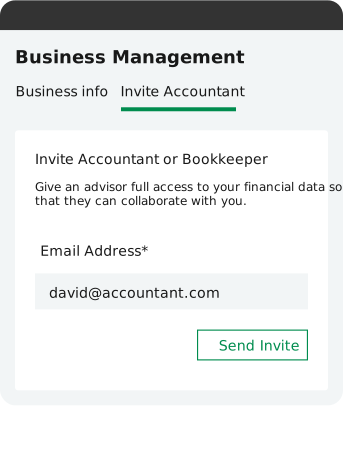
With software like Sage Accounting, you can better prepare for your self-assessment tax return, whether you do it yourself or work with an accountant. All the information you need to declare is kept accurate, compliant, and digitised in one place. You can also use Sage Accounting to work more collaboratively with your accountant, sharing real-time information in a secure way – and you can use clear financial information to plan your tax year together.

Sage Accounting helps you capture, categorise, and automate data for your self-assessment tax return in one place. Get ready for the October 2024 deadline today by keeping digital records and optimising your self-employment income with Sage Accounting.

  • Stay compliant and get total peace of mind that your tax return data is accurate
  • Plan your tax year effectively with up-to-date information
  • Store the relevant information for the right amount of time 
  • Automate bank reconciliation and upload receipts or documents to Sage Accounting for faster and more accurate data capture
  • Simplify the process of gathering data for your self-assessment tax return so you can complete it yourself
  • Improve collaboration with your accountant if you choose to work with one for your tax return

All of our customers get free, award-winning support by phone, email, and online chat.

Telephone and chat support available 8:00 a.m. to 8:00 p.m., Monday to Friday. Webchat support only on Saturdays and Sundays, 8:00 a.m. to 6:00 p.m.

Pre-recorded webinars are available to watch any time that suits you.

You will also get 24/7 access to the following support resources:

Our online community Sage City: Ask questions, share ideas, and solve issues with Sage Accounting customers and product experts.

Step-by-step video guides.

Instructor-led courses: For anyone wanting to take their skills to the next level, we have hundreds of courses designed for multiple experience levels and job roles.

Get certified and earn badges that show your expertise and build up your resume. We are committed to providing you with world-class support for Sage Accounting at every step of your business journey.

See what our customers have to say

Find out how Sage simplifies for all types of business.
Engineering

"The time saved using Sage Accounting is easily 10 hours a month with quotes and invoices. Have yet to do my tax returns but I know it will be simpler and faster than my original manual methods."

Jim Wallace
Owner, The Local Wrought Iron Company Ltd.

Retail

"Before Sage, it took me over three weeks to go through six months’ of receipts. Now … I just take a photo and upload it to Sage every week using the app on my phone."

Rory Copplestone
Business Owner, Foxglove

Construction

“By using Sage Accounting, the time taken to create an invoice has been reduced from 10 minutes down to zero minutes.”

Gerard McElhinney
Director of Client Services, Vinehall Displays

Ready to get tax right?

Checklist

Download our checklist to get prepared for the self-assessment 15 November deadline.

Self-assessment: your questions answered

Guide

Everything you need to know about self-assessment and your tax return.

Self-assessment news and advice

 Sage Advice

Get articles, insights, and tips to help with your preparations for self-assessment from Sage Advice, our business blog.
Small Benefit Exemption Scheme Ireland: rules, limits and how to use it in your business

Small Benefit Exemption Scheme Ireland: rules, limits and how to use it in your business

Give your employees tax-free vouchers to show your appreciation of their hard work by using the Small Benefit Exemption Scheme.

Read More
Read More
Statutory sick pay: What Irish employers need to know and do

Statutory sick pay: What Irish employers need to know and do

Discover what's happening with the statutory sick pay scheme and learn about your obligations as an employer under the legislation.

Read More
Read More
E-invoicing in Ireland: How VAT modernisation will affect your business

E-invoicing in Ireland: How VAT modernisation will affect your business

Ireland is moving towards mandatory e-invoicing and real-time VAT reporting. While deadlines start in 2028, SMEs need to understand what’s coming—and how to prepare.

Read More
Read More
How to reduce business costs and improve cash flow 

How to reduce business costs and improve cash flow 

Learn how to reduce business costs without compromising on quality. Our business cost reduction strategies can help you cut overheads and boost cash flow.

Read More
Read More
Three-way matching in accounts payable: What it is and why it matters

Three-way matching in accounts payable: What it is and why it matters

Struggling with invoice errors? See how 3-way matching in accounts payable ensures accurate payments, reduces risk, and improves efficiency.

Read More
Read More
What is a pro forma invoice? 

What is a pro forma invoice? 

What is a pro forma invoice? Learn how it outlines transaction details before payment and how Irish businesses can create one efficiently.

Read More
Read More
Why financial forecasting can be your business’s best defence

Why financial forecasting can be your business’s best defence

Master financial forecasting with expert insights. Learn proven methods, avoid common pitfalls, and create accurate projections that drive business success.

Read More
Read More
What is ERP? Enterprise Resource Planning (ERP) explained

What is ERP? Enterprise Resource Planning (ERP) explained

What is ERP? Learn how enterprise resource planning systems work, their benefits, and whether ERP is right for your business.

Read More
Read More

Accountant or bookkeeper in practice?

Get Sage Accounting Plus free with Partner Edition.