Why are managers under pressure and what can HR do about it?
Discover why managers are feeling more pressure than ever and explore practical HR strategies to reduce stress, prevent burnout, and improve support.


Managers are being asked to do more than ever.
They’re expected to deliver results, support employee wellbeing, develop skills, manage performance, and help teams adapt to constant change.
But the support around them hasn’t always kept pace. Sage’s HR and Payroll Leaders’ Report found that 78% of HR managers feel more stretched than they did 2 years ago, while 49% feel stressed about their jobs.
HR managers are also under growing pressure to support stressed line managers across the wider business.
So why are managers today under so much pressure?
The research points to a wider issue: managers are being asked to lead digital transformation, support wellbeing, develop skills, improve retention, and manage performance, but many still lack the time, tools, and support needed to do all those things effectively.
In this article, we’ll look at why pressure is rising and what HR can do to help managers perform without burning out.
Key takeaways
- Manager pressure is rising: 78% of HR managers feel more stretched than they did 2 years ago, while 49% feel stressed about their jobs.
- The role is expanding in several directions: HR managers increasingly expect to spend more time on digital transformation, strategy, employee wellbeing, retention, and skills development.
- Pressure spreads across the organisation: stretched HR managers are also being asked to support line managers dealing with their own workload and people challenges.
- They need additional support to handle this increased responsibility: 86% of survey respondents say that investment in modern HR technology would help tackle their challenges, while 85% say the same about support from senior business leaders.
- Consistent support matters: clear priorities, practical tools, regular check-ins, and early visibility into workload can help managers deal with pressure before it becomes burnout.
Here’s what we’ll cover:
Why are managers under so much pressure?
For HR managers, workloads are becoming broader as well as heavier, with responsibility stretching across more areas of the business.
Sage’s research shows how quickly the role is expanding.
Over the next 5 years, 63% of HR managers expect to spend more time on digital transformation and 60% on strategic planning.
The same proportion expect to do more around employee wellbeing and working practices, while 59% expect to spend more time retaining talent and supporting skills development.
That means managers are increasingly moving between very different demands.
They might be helping set strategy in one meeting, dealing with a wellbeing concern in the next, then trying to solve a skills gap or manage performance later that day.
And the pressure doesn’t stop with their own workload.
HR managers are stretched by their own expanding remit while also being asked to support line managers facing pressure elsewhere in the organisation.
Manager workload challenges are already an issue, and they’re only increasing.
It’s easy to understand why managers are stressed nowadays.
This is why growing pressure on managers shouldn’t automatically be seen as a performance issue.
When the remit keeps expanding, managers need the capacity, tools, and support to expand with it.
Without them, asking people to simply become more resilient only addresses the symptom.
Infographic: Managers under pressure
Discover the key challenges facing HR and payroll leaders, plus practical actions, tools, and metrics to better support managers, reduce burnout risk, and build stronger leadership capability.
Why manager burnout needs a wider response
When managers are stretched, it can be tempting to focus on the individual: better time management, more resilience training, or another course on managing stress.
But Sage’s research points to a wider support gap. 86% of HR leaders say investment in modern HR technology would help them tackle their challenges, while the same proportion say this about HR-specific AI tools.
85% point to increased upskilling in HR capabilities, and 85% to stronger support from senior business leaders.
At the same time, almost 80% of HR managers report a greater emphasis on building leadership capability, yet many still lack the tools and training they need.
HR leaders also want more support, training, and digital tools for line managers across the wider business.
That creates a clear mismatch.
Expectations are rising, but the support systems, training, and technology available to managers aren’t always keeping pace.
You can help close that gap by making effective management easier: clearer expectations, better access to information, practical training, and regular support built into the way managers work.
The more consistently managers are enabled, the less likely they are to reach the point where pressure has already become burnout.
What happens when managers are overstretched?
Sustained pressure takes its toll on manager wellbeing at work, making it harder for managers to lead with the same level of attention and judgement.
When managers are constantly switching between competing priorities, important parts of the role can get squeezed.
Coaching gets rushed. Feedback is delayed.
Workload problems are easier to miss, and difficult conversations may happen later than they should.
Employees feel the effects too.
Managers shape much of the day-to-day employee experience, from how clearly expectations are set to whether people feel supported when something goes wrong.
When a manager is stretched, providing that consistency becomes harder.
Performance can suffer in a similar way.
An overloaded manager may keep day-to-day work moving, but there’s less space to step back and plan.
Team development can slip, while smaller problems go unnoticed and may eventually become even bigger ones.
How HR can better support managers
You can’t remove every source of pressure, but you can make it easier for managers to handle by giving them better visibility into workload, wellbeing, and performance.
The goal is to give them clearer expectations, practical tools, and regular support before problems build up.
To start with, focus on 4 areas: clearer priorities, practical tools, regular routines, and early visibility into wellbeing and performance.
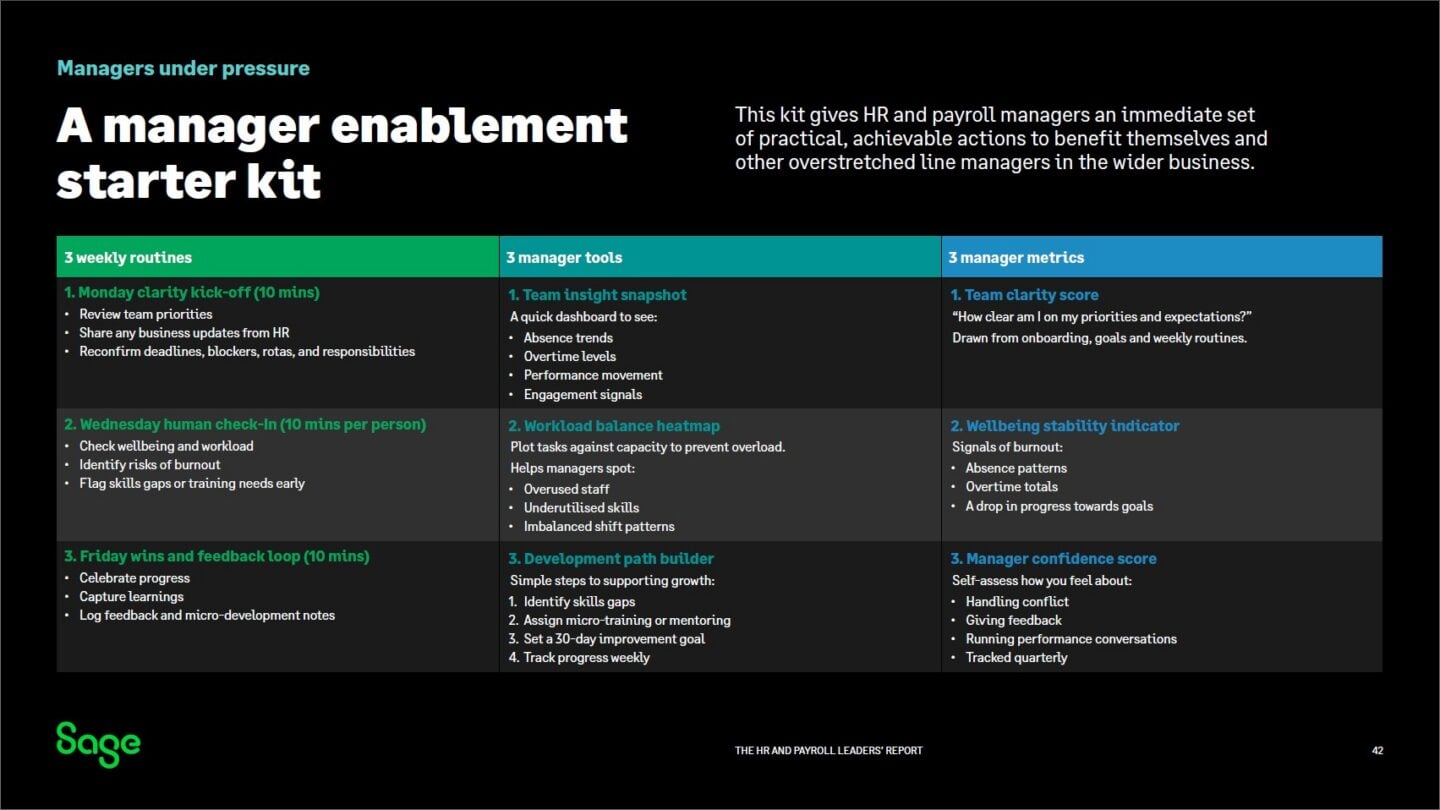
The advice in this section leans on Sage’s manager enablement starter kit (below), which is included in the full report.
1. Give managers clearer priorities
When everything feels urgent, managers need help deciding what comes first.
Make priorities explicit, especially when new work is added.
Managers should know what matters most, what they’re responsible for, and where they have room to make their own calls.
A 10-minute Monday check-in can help managers confirm priorities, identify blockers, and clarify responsibilities before the week begins.
Use it to confirm priorities and surface anything that could get in the way.
2. Equip managers with practical tools
Make the information managers need easy to access.
Sage’s manager enablement starter kit highlights 3 practical tools that help managers spot problems earlier and make more informed decisions.
- A team insight snapshot brings together absence, overtime, performance, and engagement data so managers can identify trends before they become bigger issues.
- A workload balance heatmap helps managers compare workload against available capacity, making it easier to identify overloaded employees, underused skills, and uneven work allocation.
- A development path builder helps managers identify skills gaps, agree development actions, and track progress towards clear improvement goals.
The goal is to give managers enough visibility to spot emerging problems and act before they escalate.
3. Build support into the working week
Don’t wait for a quarterly review or a problem to escalate before checking how people are doing.
Sage’s manager enablement starter kit recommends simple weekly routines:
- clarify priorities at the start of the week on Mondays,
- check workload and wellbeing midweek on Wednesdays,
- then finish by recognising progress and capturing feedback on Fridays.
These don’t need to become long meetings.
Even 10 minutes can help uncover workload concerns, wellbeing issues, or skills gaps before they begin affecting performance or increasing burnout risk.
Give managers somewhere to turn outside those check-ins too.
A manager forum, HR office hours, or peer network can give them a place to raise difficult questions and learn from others facing similar situations.
4. Track whether managers are coping
Check in on managers themselves, rather than relying only on how their team is performing.
Sage’s manager enablement starter kit suggests a manager confidence score, where managers regularly assess how comfortable they feel handling areas such as conflict, feedback, and performance conversations.
Use that alongside regular conversations about workload and priorities.
A drop in confidence, growing workload, or repeated requests for help can give HR an early signal that someone needs more support.
Infographic: Managers under pressure
Discover the key challenges facing HR and payroll leaders, plus practical actions, tools, and metrics to better support managers, reduce burnout risk, and build stronger leadership capability.
Start small and grow
Supporting managers doesn’t have to mean launching a major new programme.
Start by identifying one source of pressure you can improve.
Maybe priorities are unclear, or managers don’t have enough visibility into workload.
You might also find that difficult conversations are where they need the most support.
Then introduce one practical change to address it.
That could be a clearer weekly priority check-in, a workload tool, or more regular support from HR.
Once that change becomes part of how managers work, build from there.
The aim is to create consistent support that helps managers address pressure early, before stress, burnout, and performance issues start affecting their teams.
Want to put these ideas into action?
Download the Managers Under Pressure infographic for practical tools, weekly routines, and manager support frameworks you can start using today.
Frequently asked questions about manager pressure and burnout
What causes manager burnout?
Manager burnout can develop when demands keep rising without a corresponding increase in capacity or support.
A broader remit can leave managers juggling competing priorities while still being expected to support the people around them.
What are the signs that a manager is under too much pressure?
Changes in workload can be an early warning sign.
Rising overtime or absence may indicate that pressure is building, while slipping progress can show that a team is struggling to keep up.
Talk to managers directly too.
Ask whether their priorities feel clear and where they’re finding the role most difficult.
Sage’s manager enablement framework also recommends checking managers’ confidence in areas such as feedback and performance conversations.
How can HR support stressed managers?
Start by making the job easier to navigate.
Managers should know what matters most and have access to the information they need without having to chase HR for every answer.
Regular check-ins also give them a chance to raise workload concerns or ask for help before problems escalate.
Support works best when it becomes part of everyday management rather than something offered only when someone is already struggling.
How can organisations reduce pressure on managers?
The first step is to identify where the pressure is coming from.
If unnecessary work is consuming managers’ time, look for ways to remove or simplify it.
If they lack confidence in parts of the role, focus support and training there.
Sage’s research also shows that HR leaders see better technology and stronger senior leadership support as important ways to tackle the challenges they face.
How can technology help managers manage their teams?
Technology can make important team information easier to see in one place.
Instead of piecing together different sources, managers can get a clearer view of workload, wellbeing, and performance and spot potential problems sooner.
Subscribe to the Sage Advice newsletter
Join more than 500,000 UK readers and get the best business admin strategies and tactics, as well as actionable advice to help your company thrive, in your inbox every month.

Browse more topics from this article
Explore more wisdom

Employment status: Meaning and importance
Employment status might sound like a dry topic, but it’s critical for small businesses. Learn what it means in this article.