The Sage SME Performance Pulse, which draws on anonymised accounting data from nearly 150,000 SMEs, found profit growth has accelerated consistently over recent quarters, reaching its highest level since Q1 2022.
This comes as the UK economy expanded by 0.6% quarter-on-quarter in Q1 2026, according to the Office for National Statistics (ONS), up from 0.2% in Q4 2025. Against this backdrop, SME revenues increased by 3.2%, marking a fourth consecutive quarter of growth - its highest level since 2022. The findings underline the resilience and ambition of small businesses across the UK.
"The UK's small business community continues to demonstrate extraordinary resilience to adapt and grow," said Derk Bleeker, Chief Commercial Officer at Sage. "The fact that profitability has reached its highest level in four years is a testament to the determination and ingenuity of business owners across the country. It also highlights the opportunity that exists to help SMEs build on this momentum and unlock even greater growth in the years ahead."
Late payments continue to hold back further growth
As the Small Business Protections (Late Payments) Bill progresses through Parliament, Sage's latest data highlights the scale of the challenge facing UK SMEs. Late payments are estimated to cost the UK economy £11 billion every year, limiting the ability of businesses to invest, hire and grow.
Nearly half of all SME invoices (49%) are overdue, with businesses waiting an average of 27 days to receive payment after issuing an invoice. The delays are creating a ripple effect across the economy, with SMEs themselves now taking an average of 37.1 days to pay supplier invoices, up from 31.9 days in Q1 2025.
"Sage’s data shows that more needs to be done to tackle late payments, with too many small businesses still waiting weeks to be paid,” said Emma Jones, Small Business Commissioner. “That’s why action to improve payment practices is so important. It gives firms greater certainty over their cash flow and the confidence to invest, hire and grow. Tackling late payments isn’t just about fairness; it’s essential to unlocking the full potential of the UK’s small businesses."
The Bill represents a turning point in how cash flow is unlocked by levying financial penalties on businesses that persistently pay their suppliers late. In addition to the Bill, the Government is taking further steps to tackle late payments, with the introduction of e-invoicing from 2029. E-invoicing – the digital exchange of invoice data directly between buyers’ and suppliers’ financial systems - can help businesses operate more efficiently, as an e-invoice typically gets paid five to seven days sooner.
SME growth remains broad-based across the UK
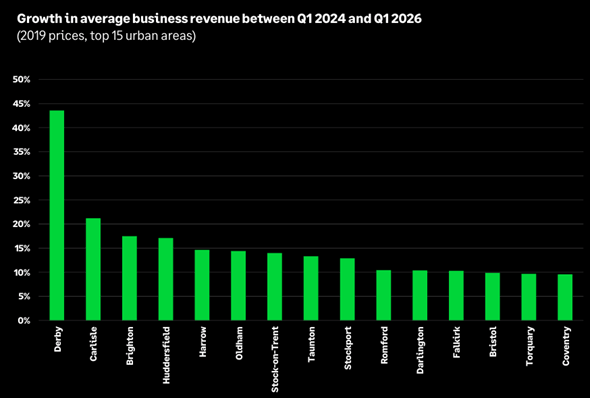
The latest regional data highlights the breadth of the UK's small business economy. The East Midlands currently leads the country on profitability, with growth of 20.2%, followed by the West Midlands at 16.3% and London at 10.6%. Derby continues to rank first for two-year revenue growth at 43.6%, the strongest of any UK city for three consecutive quarters.
While performance varies by region and sector, the findings suggest growth is being supported by a diverse mix of industries, from manufacturing and professional services to technology and finance. Together, the rankings paint a picture of a resilient SME economy, with businesses across the country continuing to contribute to growth.
Source: Sage, Smart Data Foundry, ONS, Cebr
"The regional data highlights the diversity of the UK's SME economy," said Liam Daly, Senior Economist at Cebr. "While different regions are benefiting from different sector strengths, the first quarter results showcase broad-based growth despite a challenging economic climate. From manufacturing and professional services to technology and finance, businesses across the country continue to create opportunities, invest and contribute to local economies."
Find out more about the Sage SME Performance Pulse for Q1 2026
About the Sage SME Performance Pulse
The Sage SME Performance Pulse is a quarterly measure of UK SME health and behaviour, drawing on anonymised accounting and payroll data from nearly 150,000 businesses using Sage software. The Smart Data Foundry aggregates and cleans the data; Cebr deflates and analyses it ahead of publication. The Pulse is hosted on Sage's Data For Good platform and is designed to complement traditional economic indicators by showing what businesses are actually doing, in real time. Data is produced in partnership with Cebr.
Sage exists to knock down barriers so everyone can thrive, starting with the millions of Small and mid-sized businesses served by us, our partners and accountants. Customers trust our finance, HR and payroll software to make work and money flow. By digitalising business processes and relationships with customers, suppliers, employees, banks and governments, our AI-powered platform connects SMBs, removing friction and delivering insights. Knocking down barriers also means we use our time, technology and experience to tackle digital inequality, economic inequality and the climate crisis.
UK SME profits grew by 7.4% in the year to Q1 2026, up from 5.5% the previous quarter and the highest rate of growth since Q1 2022. Real revenues increased by 3.2%, marking a fourth consecutive quarter of positive growth. However, nearly half of all SME invoices (49%) remain overdue, with businesses waiting an average of 27 days to receive payment after issuing an invoice.
Late payments are creating a ripple effect across the economy. SMEs are now taking an average of 37.1 days to pay their own supplier invoices, up from 31.9 days in Q1 2025 — a direct consequence of delays in receiving payment themselves. Late payments are estimated to cost the UK economy £11 billion every year, limiting the ability of businesses to invest, hire, and grow.